


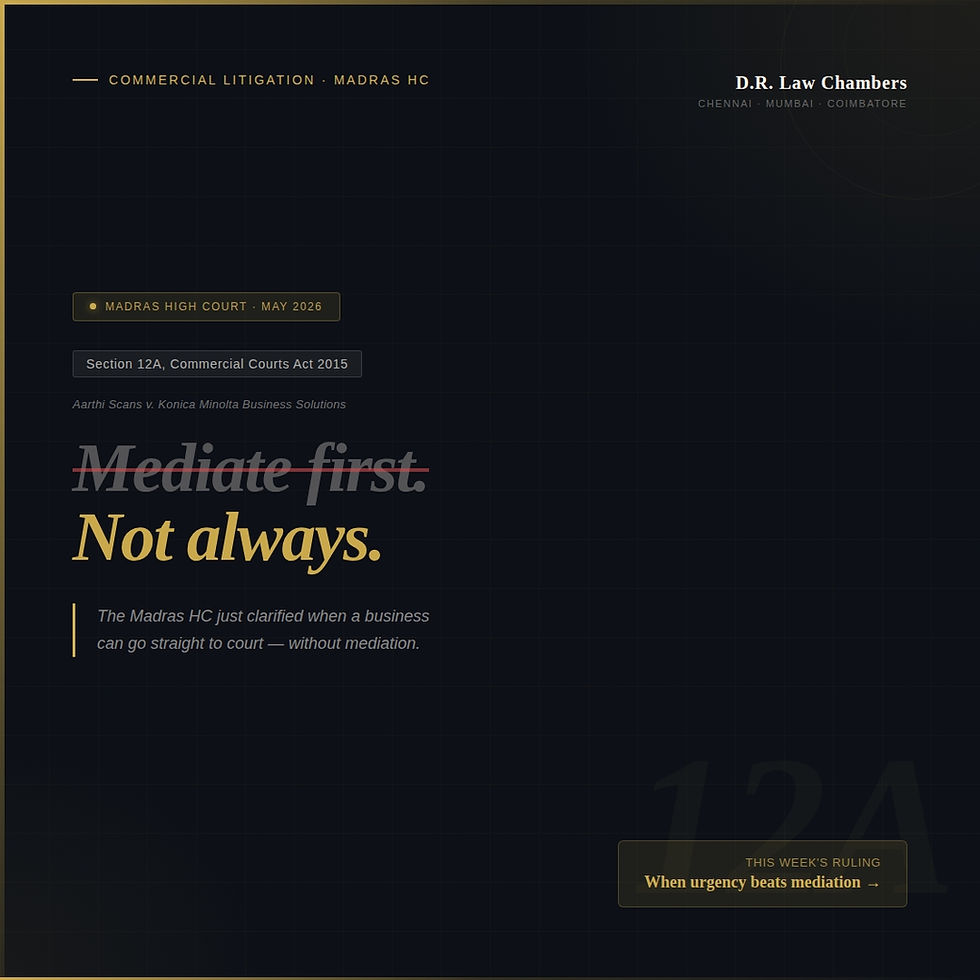
WHEN URGENCY BEATS MEDIATION

Section 12A of the Commercial Courts Act, 2015 and the Evolving Jurisprudence on Pre-Institution Mediation in India
By Dhanaram Ramachandran | Founder, D.R. Law Chambers | 2026
EXECUTIVE SUMMARY Section 12A of the Commercial Courts Act, 2015 mandates that every commercial suit must undergo pre-institution mediation before it can be filed — unless the suit contemplates urgent interim relief. The Supreme Court has held this provision to be mandatory. But the exception for urgent interim relief has produced a body of jurisprudence that is as nuanced as it is consequential for businesses. This article traces the evolution of that jurisprudence from the foundational ruling in Patil Automation v. Rakheja Engineers (2022), through the Madras High Court's pioneering five-parameter framework in K. Varathan v. Prakash Babu (2022), the Supreme Court's paradigm-shifting decision in Yamini Manohar v. T.K.D. Keerthi (2023), to the most recent Madras High Court ruling in Aarthi Scans v. Konica Minolta (2026). It distils the law into a practical framework that every business owner, in-house counsel, and litigant should understand before initiating commercial litigation in India. |
I. INTRODUCTION: A QUESTION EVERY COMMERCIAL LITIGANT FACES
Most businesses entering commercial litigation in India today encounter the same question at the threshold:
Do you have to mediate before you sue?
Under Section 12A of the Commercial Courts Act, 2015, the answer is almost always yes. Pre-institution mediation is a mandatory pre-condition to filing a commercial suit. The Supreme Court has been emphatic on this point, and suits filed without exhausting pre-institution mediation are liable to be rejected at the threshold under Order VII Rule 11 of the Code of Civil Procedure.
There is, however, one statutory exception — suits that contemplate urgent interim relief. That single phrase has generated more litigation, more confusion, and more strategic gamesmanship than perhaps any other provision in modern Indian commercial procedure.
What counts as urgent? Who decides? Can a plaintiff manufacture urgency to bypass mediation? Can a defendant be denied interim relief because mediation was not attempted?
This article examines those questions through the lens of the four most significant judgments on Section 12A — the foundational ruling in Patil Automation Pvt. Ltd. v. Rakheja Engineers Pvt. Ltd. (2022), the Madras High Court's five-parameter framework in K. Varathan v. Prakash Babu Nakundhi Reddy (2022), the Supreme Court's paradigm-shifting decision in Yamini Manohar v. T.K.D. Keerthi (2023), and the most recent Madras High Court ruling in Aarthi Scans Pvt. Ltd. v. Konica Minolta Business Solutions (2026). It distils the resulting law into a practical framework for businesses and litigants.
II. THE STATUTORY FRAMEWORK
A. The Legislative Backdrop
Section 12A was not in the Commercial Courts Act, 2015 when it was originally enacted. It was introduced by the Commercial Courts (Amendment) Act, 2018, with effect from 3 May 2018. The legislative purpose was clear and articulated in the Statement of Objects and Reasons — to encourage mediation as a meaningful alternative to litigation, to reduce the workload of commercial courts, and to facilitate the speedier disposal of commercial disputes.
The provision came against the backdrop of India's chronic commercial litigation pendency. Commercial courts established under the 2015 Act were intended to deliver time-bound resolution of commercial disputes. That goal was being undermined by the sheer volume of filings. The 2018 amendment sought to filter out cases that could be resolved through mediation before they ever reached the docket.
B. The Text of Section 12A
Section 12A reads as follows:
Section 12A, Commercial Courts Act, 2015 "(1) A suit, which does not contemplate any urgent interim relief under this Act, shall not be instituted unless the plaintiff exhausts the remedy of pre-institution mediation in accordance with such manner and procedure as may be prescribed by rules made by the Central Government..." |
The statutory architecture is straightforward in form, but layered in substance:
• Every commercial suit must, as a rule, undergo pre-institution mediation
• The exception is suits that contemplate urgent interim relief
• The mediation is to be conducted by authorities notified by the Central Government, typically the State Legal Services Authorities under the Legal Services Authorities Act, 1987
• The mediation must be completed within three months of the application, extendable by two months with the consent of the parties
• If mediation succeeds, the resulting settlement has the status of an arbitral award under Section 30(4) of the Arbitration and Conciliation Act, 1996 — directly enforceable
C. The Pre-Patil Automation Position: A House Divided
Between 2018 and 2022, High Courts across India took divergent positions on whether Section 12A was mandatory or merely directory.
The Bombay High Court, in Deepak Raheja v. Ganga Taro Vairani (2021), held the provision to be mandatory in cases not involving urgent relief, emphasising the legislative intent to expedite commercial disputes. The Calcutta High Court in Laxmi Polyfab v. Eden Realty Ventures (2021) reached a similar conclusion. The Madras High Court, however, had initially taken the view that the provision was directory.
This divergence created uncertainty for litigants. Defendants would argue Section 12A was mandatory and seek rejection of plaints. Plaintiffs would argue it was directory and seek to maintain their suits. The same fact pattern could produce different outcomes in different High Courts. The Supreme Court had to step in.
III. THE FOUNDATIONAL RULING: PATIL AUTOMATION V. RAKHEJA ENGINEERS
CASE LAW: Patil Automation Pvt. Ltd. and Ors. v. Rakheja Engineers Pvt. Ltd. (2022) 10 SCC 1; 2022 SCC OnLine SC 1028 — Supreme Court of India (Justices K.M. Joseph and Hrishikesh Roy, decided on 17 August 2022) Facts: A consolidated batch of appeals raising the same question — whether pre-institution mediation under Section 12A of the Commercial Courts Act is mandatory, and whether failure to comply with it requires rejection of the plaint under Order VII Rule 11 CPC. Held: The Supreme Court held that Section 12A is mandatory. Any suit instituted without exhausting pre-institution mediation, save those contemplating urgent interim relief, must be visited with rejection of the plaint under Order VII Rule 11. The Court further held that this power can be exercised even suo motu by the court. The ruling was given prospective effect from 20 August 2022. |
The reasoning of the Court is worth examining closely, as it forms the foundation of all subsequent jurisprudence.
The Court rejected the argument that Section 12A was merely a procedural provision. It held that the design and scope of the 2018 amendment made clear that Parliament intended a mandatory regime. The benefits of mediation — to the parties, and more importantly to the justice delivery system as a whole — could not be realised if compliance was optional.
The Court invoked the principle in Sharif-ud-Din v. Abdul Ghani that where the object of a law would be defeated by non-compliance, the provision must be regarded as mandatory. Allowing parties to bypass mediation would not just violate the express language of Section 12A. It would frustrate the entire object of the 2018 amendment.
Critically, the Court left two questions open for future jurisprudence:
• What does it mean for a suit to "contemplate" urgent interim relief?
• How can courts prevent parties from manufacturing urgency as a device to bypass Section 12A?
Those questions would be answered, first by the Madras High Court, and then definitively by the Supreme Court itself in Yamini Manohar.
IV. THE MADRAS HIGH COURT'S FIVE-PARAMETER FRAMEWORK
CASE LAW: Mr. K. Varathan v. Mr. Prakash Babu Nakundhi Reddy C.S. (Comm. Div.) No. 202 of 2022; 2022 LiveLaw (Mad) 475 — Madras High Court (Justice M. Sundar) Facts: An audio-visual equipment supplier filed a commercial suit for recovery of approximately Rs. 26 lakhs from its customer. The plaintiff sought an injunction restraining the defendant from alienating its assets, claiming urgency. The defendant raised the bar of Section 12A — pre-institution mediation had not been attempted. The plaintiff argued that the suit contemplated urgent interim relief. Held: Justice M. Sundar rejected the plaint. The Court held that 'interim relief' and 'urgent interim relief' are conceptually distinct — every suit may seek interim relief, but only suits genuinely contemplating urgent interim relief escape the mandate of Section 12A. The Court found that the plaintiff had sent a demand notice in March, remained dormant for five months, and only then approached the court on the bare apprehension that the defendant might sell his assets. This was not urgent interim relief — it was an attempt to bypass mediation. |
The lasting contribution of K. Varathan lies not in the result but in the framework Justice Sundar laid down. The Court identified five parameters that a commercial court must apply when assessing whether a plaint genuinely contemplates urgent interim relief:
# | Parameter | What the Court Asks |
1 | Profound Thinking | Is the prayer for interim relief a product of profound thinking carefully about the possibility of the happening — or is it a hurriedly drafted afterthought? |
2 | Prompt Attention | Does the matter genuinely demand prompt attention — is there a real and immediate risk that cannot wait for mediation? |
3 | Pressing Necessity | Is there a pressing necessity, calling for the immediate action of the court? |
4 | Antecedent Conduct | Has the plaintiff acted with corresponding urgency in the period leading up to the suit — issuing notices promptly, following up diligently, or has the plaintiff slept on its rights? |
5 | Tactical Avoidance | Does the prayer for urgent interim relief, viewed against the entire conduct of the parties, appear to be a genuine concern — or a tactical device to escape the mandate of Section 12A? |
The K. Varathan framework is significant for two reasons. First, it gave commercial courts an actionable test for what had been an indeterminate concept. Second, it introduced the analysis of antecedent conduct — the plaintiff's behaviour before filing the suit becomes evidence of whether the urgency is genuine or manufactured.
Justice Sundar also made a critical observation that has been cited approvingly in subsequent judgments — that the urgency to seek interim relief must exist at the time of filing the suit. It cannot be an ex post facto jurisdictional fact created after the suit is filed.
V. THE PARADIGM-SHIFTING DECISION: YAMINI MANOHAR V. T.K.D. KEERTHI
CASE LAW: Yamini Manohar v. T.K.D. Keerthi 2023 SCC OnLine SC 1382 — Supreme Court of India (Justices Sanjiv Khanna and S.V.N. Bhatti, decided on 13 October 2023) Facts: A commercial suit was filed before the District Judge, Commercial Court at Saket, Delhi, with a prayer for urgent interim relief. The defendant filed an application under Order VII Rule 11 CPC seeking rejection of the plaint on the ground that the urgent interim relief sought was a smokescreen — the plaintiff was attempting to bypass Section 12A. The Commercial Court rejected this application. The Delhi High Court upheld the rejection. The defendant approached the Supreme Court. Held: The Supreme Court upheld the rejection of the defendant's Order VII Rule 11 application. But the importance of the judgment lies in what the Court said about the test to be applied. The Court held that the words 'contemplate any urgent interim relief' in Section 12A must be read as conferring power on the commercial court to be satisfied that the urgency is genuine. It is not a matter of the plaintiff's absolute and unfettered discretion. Courts must examine the nature and subject matter of the suit, the cause of action, and the prayer for interim relief — to ensure that the prayer is not a disguise to wriggle out of Section 12A. |
THE SUPREME COURT'S KEY HOLDING "The prayer for urgent interim relief should not be a disguise or mask to wriggle out of and get over Section 12A of the CC Act. The plaint, documents and facts should show and indicate the need for an urgent interim relief." — Yamini Manohar v. T.K.D. Keerthi, 2023 SCC OnLine SC 1382 |
Yamini Manohar is the paradigm-shifting decision in this area for three reasons:
First, it rejected the absolute and unfettered right interpretation. Some High Courts had taken the view that whenever a plaintiff seeks urgent interim relief, the case automatically falls outside Section 12A. The Supreme Court held this view to be incorrect. The mere prayer for urgent interim relief is not enough — the court must be satisfied that the urgency is real.
Second, it gave commercial courts an active gatekeeping role. The court must look at the plaint, the documents, and the facts to determine whether the urgency is contemplated genuinely. This is not a high-bar inquiry — but it is a real inquiry. The plaintiff cannot simply attach an interim relief prayer and expect the court to accept it at face value.
Third, it preserved access to commercial courts where urgency is real. The Court was equally clear that genuine urgency justifies bypassing mediation. The provision should not be used to deny legitimate access to courts where the dispute genuinely requires immediate judicial intervention.
Importantly, the Supreme Court's framework — while not explicitly adopting the K. Varathan parameters — operates in a complementary way. The Madras High Court's five-parameter framework provides the operational detail; the Supreme Court's Yamini Manohar judgment provides the high constitutional principle. Together, they form the law of Section 12A as it stands today.
VI. THE MOST RECENT DEVELOPMENT: AARTHI SCANS V. KONICA MINOLTA
CASE LAW: Aarthi Scans Pvt. Ltd. v. Konica Minolta Business Solutions India Pvt. Ltd. Madras High Court, 2026 — Article 227 supervisory jurisdiction (decided May 2026) Facts: Aarthi Scans, a diagnostic services provider, had entered into commercial arrangements with Konica Minolta for the supply and use of printers at its premises. A dispute arose, and the equipment remained on Aarthi Scans' premises, causing continuing commercial disruption. Aarthi Scans filed a commercial suit seeking interim relief. The Principal Commercial Court at Egmore, Chennai returned the plaint, holding that there was no genuine urgency that justified bypassing Section 12A mediation. Aarthi Scans approached the Madras High Court under Article 227 of the Constitution. Held: The Madras High Court set aside the Commercial Court's order and directed the plaint to be numbered. The High Court held that the pleadings disclosed a credible and immediate commercial disruption — equipment that should not have been on the premises, an arrangement that was being suffered day by day — and that this amounted to genuine urgent interim relief within Section 12A. The Court framed the inquiry as a fact-sensitive threshold assessment of commercial urgency from the plaintiff's standpoint, while preserving safeguards against tactical avoidance of mediation. |
Aarthi Scans is significant because it operationalises the Yamini Manohar standard in a fact pattern that is endemic to Indian commercial practice — the continuing commercial burden.
In Indian business life, many commercial disputes do not involve a one-time injury that crystallises on a single date. They involve ongoing burdens — equipment that should be removed but is not, services that should be terminated but continue, contractual obligations that are being breached month after month. The question Aarthi Scans answers is whether this kind of continuing burden qualifies as urgent.
The Madras High Court's answer is yes — provided the pleadings actually disclose the burden and show how each passing day creates fresh prejudice. The Court was clear that boilerplate language will not do. The urgency must be evident from the plaint itself.
THE AARTHI SCANS PRINCIPLE Where the pleadings disclose a credible and immediate commercial disruption — an ongoing burden that is being suffered day by day — the suit qualifies as one contemplating urgent interim relief under Section 12A. The threshold is fact-sensitive, assessed from the plaintiff's standpoint, but real urgency must be evident from the pleadings themselves. |
VII. WHEN URGENCY IS GENUINE — AND WHEN IT IS NOT
Reading the four judgments together, a clear picture emerges of when urgency will be accepted and when it will not.
A. Situations Where Urgency Has Been Accepted
Courts have generally accepted urgency in the following situations:
• Trademark and copyright infringement, where the continued infringement causes ongoing irreparable damage to brand and goodwill
• Disputes involving the removal of physical equipment from premises, where each day of continued presence creates fresh commercial loss
• Threats of disposal of assets, where the plaintiff demonstrates a specific, credible apprehension of dissipation — not bare apprehension
• Continuing breach of exclusivity arrangements, where competitive harm accumulates with each day of breach
• Disputes involving perishable subject matter, where delay causes the very substance of the dispute to disappear
• Disputes where statutory limitation is about to expire and mediation would consume the remaining limitation period
B. Situations Where Urgency Has Been Rejected
Courts have rejected claims of urgency in the following situations:
• Money recovery suits without a specific factual basis for apprehension of dissipation (as in K. Varathan)
• Plaints filed many months after the cause of action arose, where the plaintiff was dormant in the intervening period
• Cases where the prayer for interim relief is broadly drafted and not tied to any specific imminent harm
• Cases where the plaintiff filed an earlier suit without urgent relief and then filed a second suit with such relief — suggesting the urgency is manufactured
• Cases where the interim relief sought is in substance the same as the main relief, suggesting the plaintiff is seeking to short-circuit adjudication
VIII. PRACTICAL GUIDANCE FOR COMMERCIAL LITIGANTS
A. For Plaintiffs Considering a Commercial Suit
If you are a business owner or in-house counsel preparing to file a commercial suit, apply the following discipline before approaching the court:
• Act promptly. Send notices early. Follow up diligently. Any period of dormancy will be used by the defendant to argue that urgency is manufactured.
• Document the urgency. The K. Varathan framework requires courts to examine antecedent conduct — your file should demonstrate that you have acted with the urgency you now claim before the court.
• Draft the urgent interim relief prayer with care. Tie it to specific, identifiable, imminent harm. Show how each passing day worsens your position.
• Plead the urgency in the body of the plaint, not just in the prayer. The Madras HC in Aarthi Scans was clear — the urgency must be evident from the pleadings themselves.
• If urgency is doubtful, consider initiating pre-institution mediation. A failed mediation may still produce a settlement framework, and at minimum it removes the Section 12A bar.
B. For Defendants Resisting a Commercial Suit
If you are a defendant in a commercial suit and believe the plaintiff has bypassed Section 12A without genuine urgency, the following strategy applies:
• File an application under Order VII Rule 11(d) CPC promptly. Delay in raising the Section 12A bar may invite an inference of waiver.
• Analyse the plaintiff's antecedent conduct. The K. Varathan framework allows you to show that the plaintiff acted without urgency before filing — undermining the claim of urgency now.
• Test the prayer for interim relief against the five K. Varathan parameters. A prayer that fails one or more parameters can be challenged.
• If the plaintiff has filed an earlier suit on the same cause of action without claiming urgency, this is powerful evidence that the present urgency is tactical.
• Engage in mediation if directed by the court. The 2018 amendment was designed to encourage settlement — and a defendant who appears willing to mediate strengthens its position before the court.
C. For Mediators and Mediation Authorities
The success of Section 12A depends not just on judicial interpretation but on the quality of the mediation process itself. Mediation authorities — typically State Legal Services Authorities — must be adequately resourced. Mediators must be trained in the substantive areas of commercial law. And mediation outcomes must be enforceable as the statute promises.
IX. CONCLUSION: THE BALANCE THE LAW HAS STRUCK
Section 12A of the Commercial Courts Act, 2015 has, over the course of less than a decade, become one of the most consequential procedural provisions in Indian commercial litigation. The journey from Patil Automation to Aarthi Scans reflects a settled jurisprudential balance — one that respects both the legislative intent to encourage mediation and the constitutional imperative of preserving access to courts where urgency is real.
The Supreme Court has held that pre-institution mediation is mandatory. But it has equally held that the exception for urgent interim relief is not a discretionary indulgence — it is a real, substantive carve-out for cases that genuinely cannot wait. The Madras High Court has provided the operational framework through K. Varathan, refined and applied most recently in Aarthi Scans.
For businesses, the message of this body of law is clear:
Mediation is not a procedural inconvenience to be evaded. It is the default route. But where your dispute genuinely cannot wait — where ongoing commercial disruption is causing fresh prejudice every day — the law will not stand in your way.
The challenge, as ever in commercial litigation, is to know which category your dispute falls into. That requires honest analysis of the facts, careful drafting of the pleadings, and a clear understanding of the jurisprudence. The cost of getting it wrong — a rejected plaint, a wasted year, or worse, a missed limitation period — is significant.
THE BOTTOM LINE FOR BUSINESSES If you are considering commercial litigation and your dispute involves a continuing commercial burden, ongoing infringement, or imminent harm — you may be able to go directly to court without mediation. If your dispute is essentially a recovery claim where you have not acted with corresponding urgency, mediation is mandatory. Either way, the path you choose at the outset will define your case. Speak to your counsel before you file — not after the plaint is returned. |
X. LEGAL PROVISIONS AND CASES CITED
Statutes
• Commercial Courts Act, 2015 — Sections 2(1)(c), 12, 12A
• Commercial Courts (Amendment) Act, 2018
• Code of Civil Procedure, 1908 — Order VII Rule 11
• Arbitration and Conciliation Act, 1996 — Section 30(4)
• Legal Services Authorities Act, 1987
• Commercial Courts (Pre-Institution Mediation and Settlement) Rules, 2018
Cases Cited
• M/s Patil Automation Pvt. Ltd. and Ors. v. Rakheja Engineers Pvt. Ltd., (2022) 10 SCC 1; 2022 SCC OnLine SC 1028
• Yamini Manohar v. T.K.D. Keerthi, 2023 SCC OnLine SC 1382
• Mr. K. Varathan v. Mr. Prakash Babu Nakundhi Reddy, 2022 LiveLaw (Mad) 475; C.S. (Comm. Div.) No. 202 of 2022
• Aarthi Scans Pvt. Ltd. v. Konica Minolta Business Solutions India Pvt. Ltd., Madras High Court, 2026
• Deepak Raheja v. Ganga Taro Vairani, 2021 SCC OnLine Bom 3124
• Laxmi Polyfab Pvt. Ltd. v. Eden Realty Ventures Pvt. Ltd., AIR 2021 Calcutta 190
• Sharif-ud-Din v. Abdul Ghani, (1980) 1 SCC 403
• Ambala Sarabhai Enterprises Ltd. v. K.S. Infraspace LLP Ltd., (2020) 15 SCC 585
 |


Comments